


.avif)


71-75 Shelton Street
Covent Garden, London,
WC2H 9JQ
Most brand strategy advice is written by people who have never had to sign off a payroll. It reads like a university module, wrapped in three Venn diagrams and a Maya Angelou quote. Useful, occasionally. Actionable, almost never.
This is the opposite. It is the field version of how I build brand strategies with challenger brand founders who need the work to pay back inside a financial year. No jargon. No cathedrals. Just the nine moves that separate the brands that compound from the brands that leak.
If you want the exhaustive, step by step masterclass, sit down with a cup of something hot and work through The Ultimate Guide to Building a Brand Strategy in 2026. This post is the ten minute version. The one you read before a Tuesday leadership call.

Start from a brutal diagnosis
Every bad brand strategy I have ever seen had one thing in common. It started from aspiration instead of truth. Someone looked at what the brand wanted to be, skipped what the brand actually is, and started drawing logos.
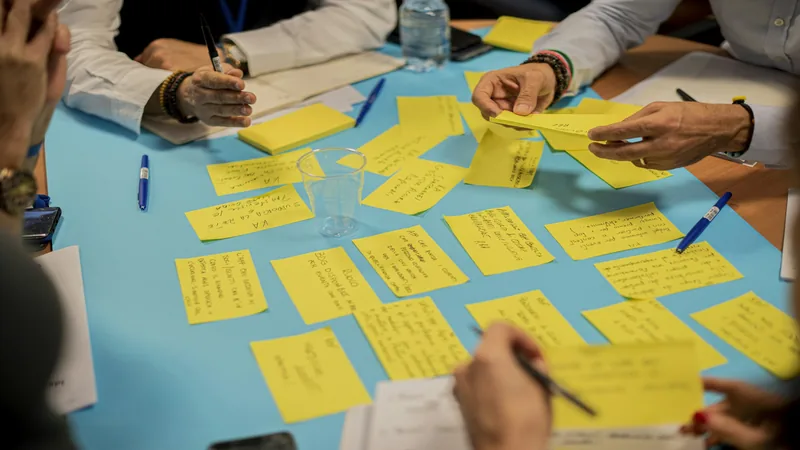
Before you write anything, buy yourself a wall, a pad of post its, and an afternoon. Answer these five questions in plain English.
- Who is paying us the most today, and why.
- Who are we ignoring that we should not be.
- What does the market think we are.
- What do we wish the market thought we were.
- What is the gap between those two, and what is in the gap.
That last question is the whole job. The gap is where your brand strategy lives. Most founders tell themselves the gap is a messaging problem. It almost never is. It is a clarity problem. You do not know who you are yet, so the market has invented a version of you that is less commercially valuable than the real one.
The diagnosis should be uncomfortable. If the wall of post its at the end of the afternoon makes everyone in the room feel good about themselves, you have done it wrong. Do it again.
Pick who you are for, specifically
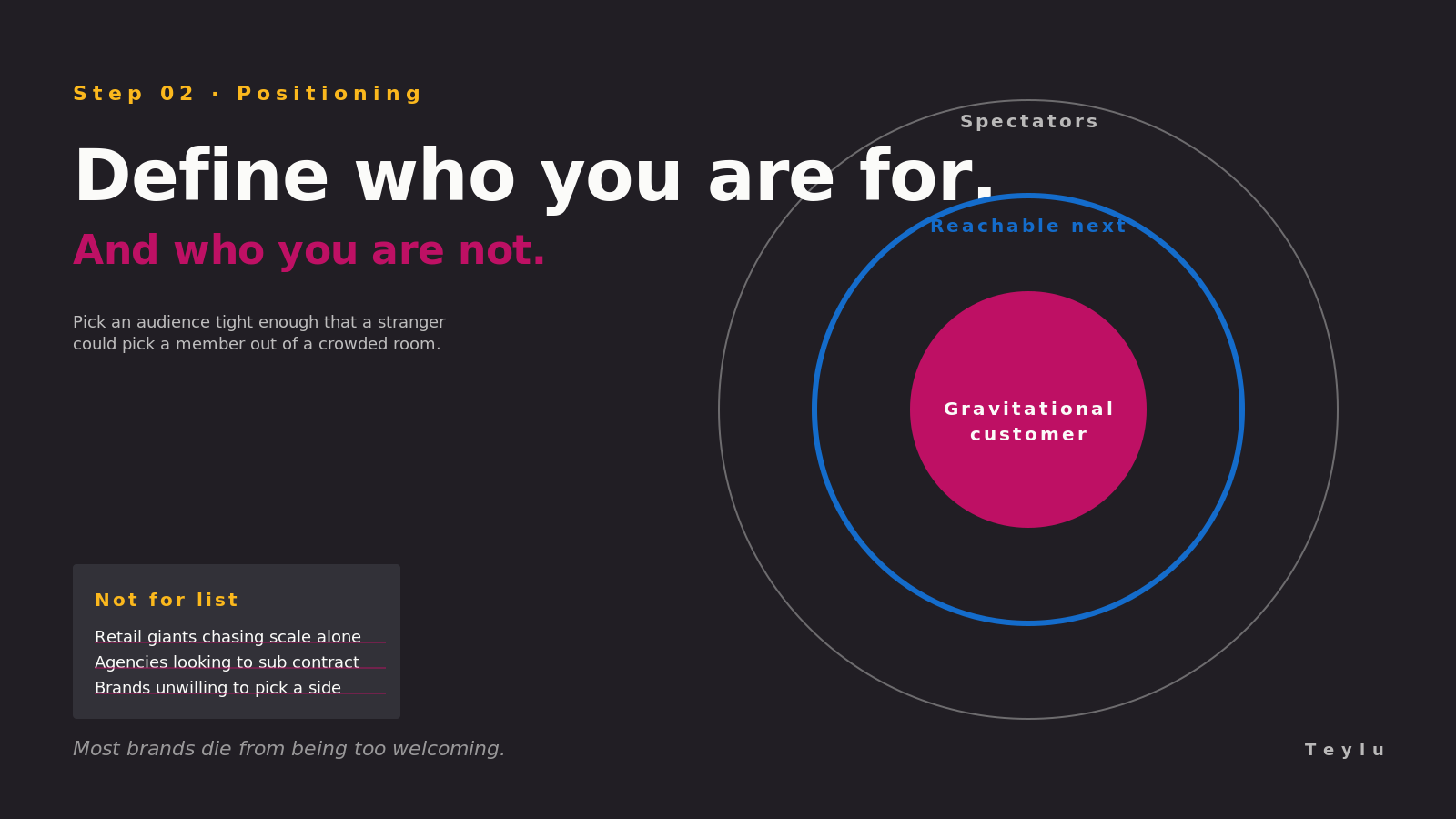
The single most profitable decision you will make this year is narrowing who you are for. I know. It sounds like losing. It is the opposite.
Think about the last five brands you recommended to a friend. You did not recommend them because they were for everyone. You recommended them because they were clearly, unmistakably for someone, and you happened to know your friend was that someone. Breadth kills recommendation. Specificity earns it.
Write a 200 word description of your inner circle customer. Not a persona deck. A description. Where they live, what they buy, what they complain about, what they love, what they pay more for, what they will forgive, what they will walk over hot coals for. If the description could also describe your biggest competitor's inner circle, you have not gone deep enough.
Now write the list nobody writes. The "not for" list. Three to five kinds of customer you will deliberately not serve. If the list feels transgressive, good. That means you have stopped being polite and started being a brand.
For our D2C clients the "not for" list is usually something like the discount hunter, the replica collector, the trend jumper. For our B2B clients it is the sub £5,000 project, the procurement first buyer, the distributor who will not co market. Naming the "not for" gives the team permission to say no. Without it, sales will keep walking the wrong customers through the door, and brand will spend the next five years cleaning up after them.
Find your wedge, not your mission
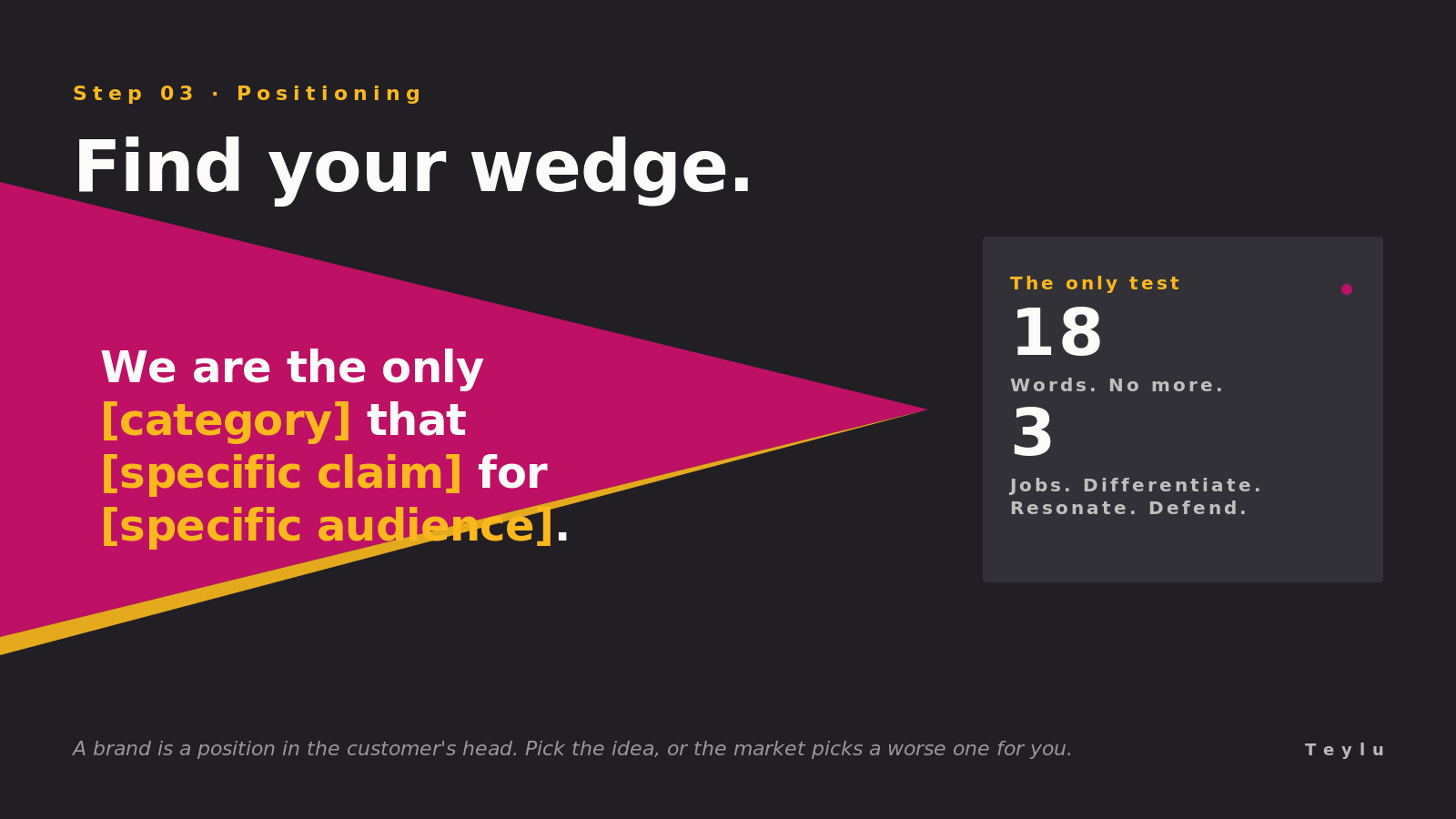
Missions are comforting. Wedges are useful.
A wedge is a single sentence that compresses your brand to its smallest, most defendable claim. It differentiates (it separates you from the obvious alternative), it resonates (it maps onto something the customer already wants), and it defends (you can prove it, today, with current capability).
The most useful test is the "only" test. Finish this sentence without flinching.
"We are the only [category] that [specific claim] for [specific audience]."
If you cannot finish it, or the sentence turns wishy as soon as you read it out loud, keep going. The wedge is rarely the first version. It is usually the sixth, after three rounds of friction with customers and two with your own sales team.
Once the wedge is set, it becomes the filter for everything. A new product launch. A new hire. A new campaign. A new partnership. Run it through the wedge. If it makes the wedge stronger, do it. If it weakens the wedge, do not, no matter how revenue accretive it looks in the short term. Ninety percent of brand strategy in year two is editing the business back to the wedge.
I wrote more about why this specifically matters in The industries set to win big from AI in marketing this year. The short version is that AI engines are going to mention the brands whose wedge is clearest on the open web. Softness used to be forgivable. In 2026 it is expensive.
Build the message architecture before you touch design
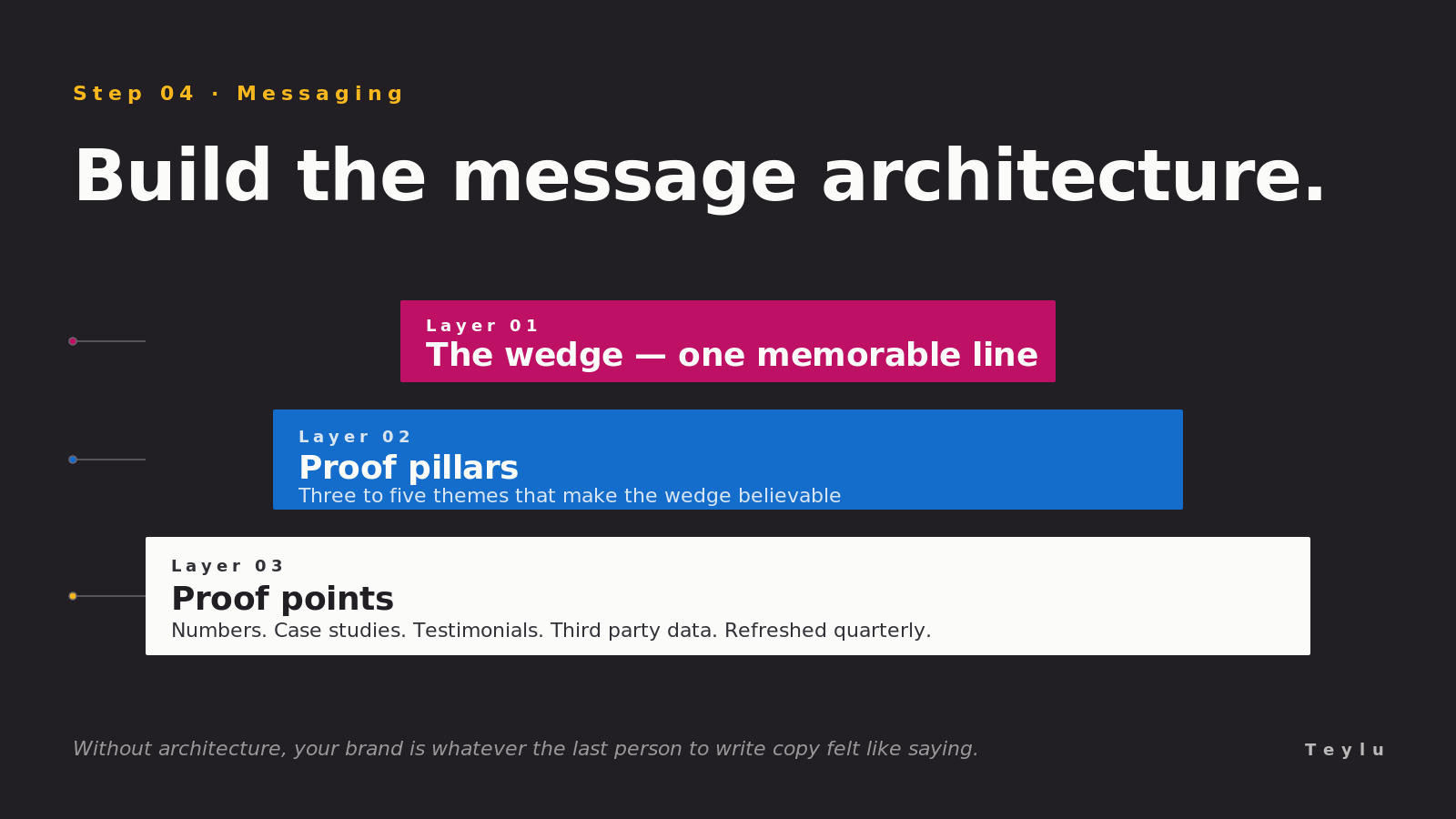
Designers are not the enemy of brand strategy. Briefing designers before you have a message architecture is.
Underneath the wedge sit three to five proof pillars. Themes that make the wedge believable. Under each pillar sit the proof points. Stories, numbers, quotes, case studies, third party validation. That is the whole architecture.
A pillar is not a brand value. Brand values are internal. Pillars are customer facing and revenue working. "Honest" is a value. "Repair for life" is a pillar. "Innovative" is a value. "Released four flagship updates in the last two years" is a pillar.
If two pillars do the same job, collapse them. If a pillar has no proof points you can cite with a straight face, either build the capability and then come back, or cut it. A pillar without evidence is a lie waiting to be discovered.
We build pillars with our clients in a single half day workshop. The trick is to close the laptops and ask the same question three different ways, until the room stops giving the marketing department answer and starts giving the customer's answer. You will know it has landed when the sales team leans in.
Codify the voice and visuals as if new hires will run them tomorrow
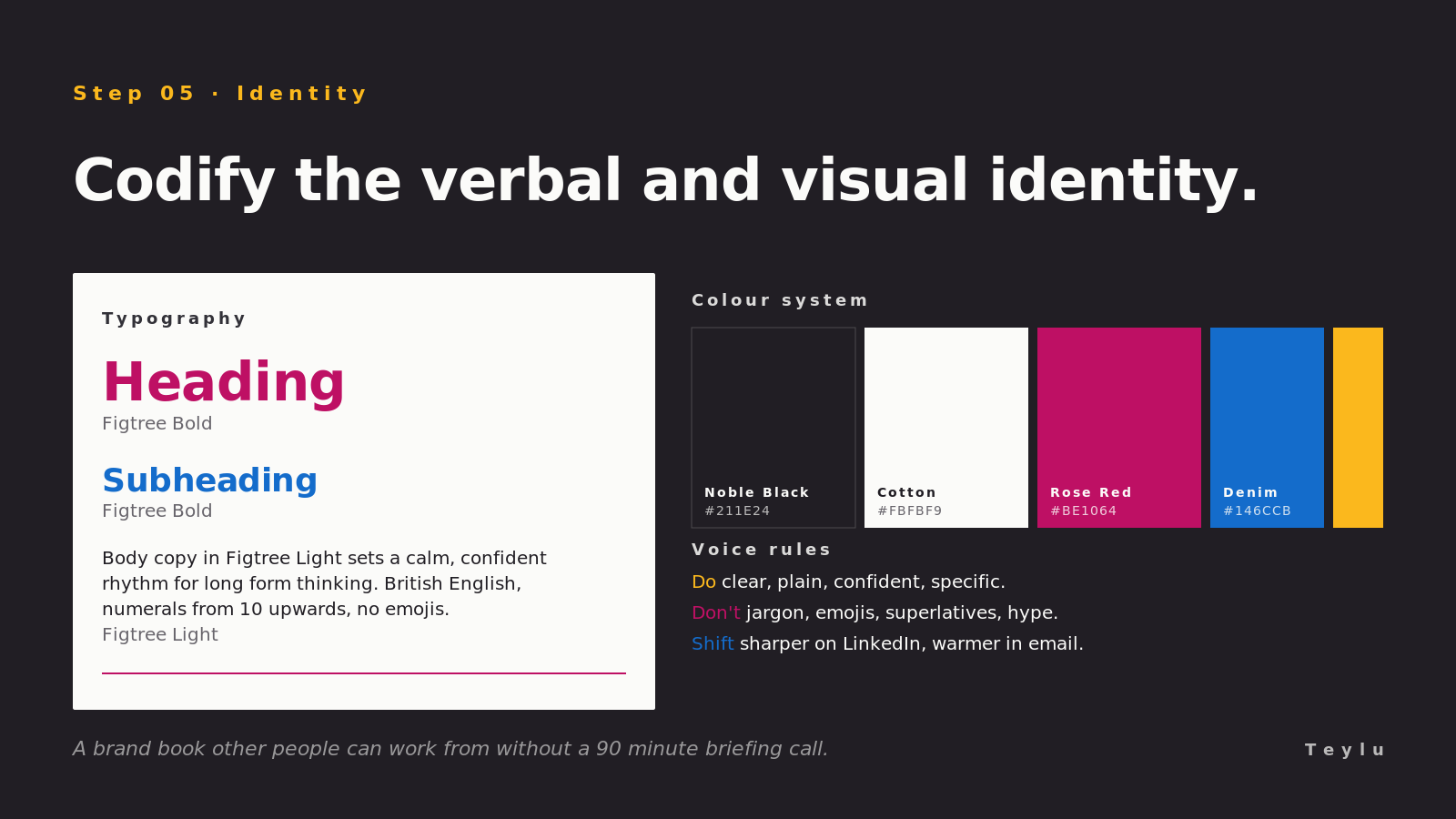
Brand books die because they get written for the people who built them. That is a mistake. Write the brand book for the designer you have not hired yet, the agency you have not briefed yet, the copywriter who will cover maternity leave in eighteen months. If all three of those people could open the book, do the work and produce something on brand without a 90 minute explainer, you have a brand book. If they could not, you have decoration.
Five rules that catch most of the trouble up front.
Write the voice with real sentences, not adjectives. "Warm but unflinching" means nothing. "We say 'here is the catch' and 'this will cost you' in public, because softening hard truths loses trust" means something.
Write a "do not say" list that is almost as long as the "do say" list. Cliché kills more challenger brands than competition does.
Build the visual identity at thumbnail size first. If your Instagram story, homepage hero, product card, email and paid ad are indistinguishable at thumbnail from five competitors, the system is not assertive enough yet.
Pick one colour that is genuinely yours. Not a Pantone match to a competitor. Not a trending hex code. One colour the customer can draw from memory. Sounds simple. Almost nobody does it.
Invest in photography direction before you over invest in illustration. Photography carries authenticity. Illustration carries aesthetic, which ages faster than most founders budget for.
Pick three channels and do them properly
The worst strategy of the decade is "be everywhere". The second worst is being nowhere. The right answer, for every challenger brand we have ever worked with, is three to five channels run properly.
Pick them with this filter. Your audience uses the channel daily. You can produce content to the standard the platform rewards, every week, for two years, with the resources you actually have. The channel lets you show your proof pillars, not just tell them. You can measure outcomes. You can imagine what winning looks like in 12 months.
If you cannot tick every box on that list for a channel, do not start on that channel. Pick another one.
A typical D2C stack that works looks like TikTok and Reels for top of funnel, Meta and Google for paid acquisition, email and SMS for retention, one or two creator partnerships for credibility, and an SEO content programme aimed at both Google and the AI engines. Five levers, all worked hard. We have written more about the economics of paid in performance marketing and paid media.
A typical B2B stack that works looks like trade press and events for credibility, LinkedIn for thought leadership, an SEO content programme for the search intent of both distributors and end users, a distributor enablement kit that gets updated monthly, and one well built case study per quarter. Same logic. Three to five levers, run properly, beat fifteen run badly every time.
Wire the brand to the till
This is the step that separates a brand strategy from an art project. Every pillar needs a commercial job.
Acquisition. Which pillar does this campaign work. If the answer is "all of them" or "none in particular", the campaign is wallpaper.
Conversion. Which pillar does this page express. If the homepage does not reflect the wedge inside three seconds of page load, the paid budget is inflating the category rather than your share of it.
Retention. Which pillar does this post purchase email reinforce. If the post purchase flow is a cut and paste from a template library, the brand stops being felt at the moment the customer is most receptive to feeling it.
This is where most brand work quietly dies. Not because the strategy is wrong. Because the handover from brand team to performance team is a broken telephone. The fix is simple and annoying. Tag campaigns by pillar, report by pillar, review by pillar, kill campaigns whose pillar cannot be identified. Nobody likes killing campaigns. Do it anyway.
Measure four things, not forty
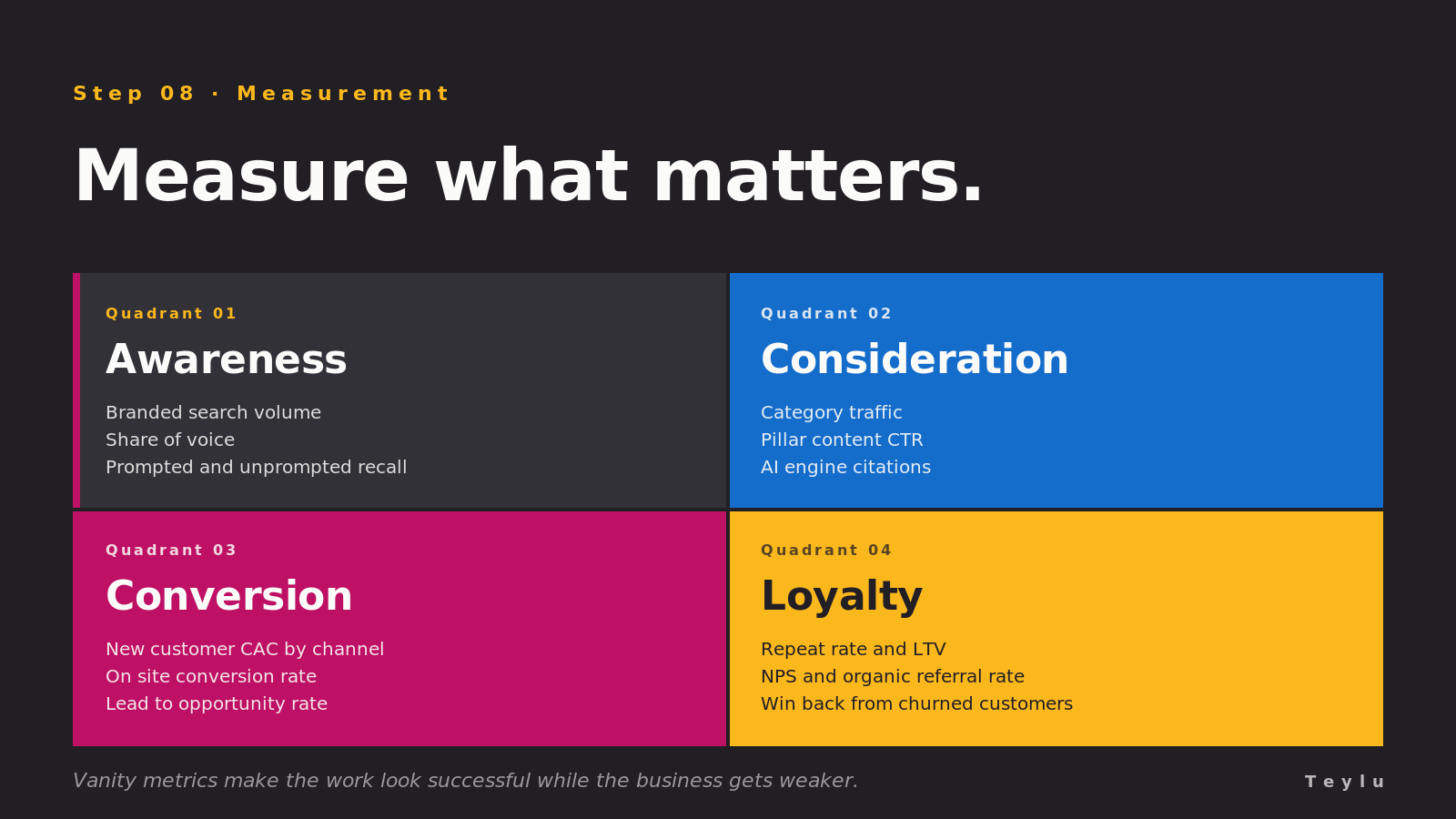
Brand dashboards drown in metrics because metrics are free. Discipline is not.
Measure these four categories. Awareness (branded search, share of voice, unprompted recall in customer surveys). Consideration (traffic from brand and category terms, time on key pages, AI engine citation tracking). Conversion (new customer CAC, on site conversion rate, lead to opportunity rate). Loyalty (repeat rate, lifetime value, referral rate, win back rate).
Three metrics per quadrant is plenty. Twelve total. If you find yourself reporting on a 47 metric dashboard, the dashboard is not the problem. The fear of being wrong is. Cut to twelve. Defend the choice quarterly.
Govern the brand or it ages
Brand strategy is not a project. It is a permanent function. The brands that compound have a small, named group who own the strategy, police its expression, and update it on a defined cadence.
Monthly brand huddle, 60 minutes, leadership from marketing, sales and product. Review the twelve metrics. Surface friction points. Agree next month's priorities. Quarterly brand review, a half day with the broader leadership team. Did the strategy hold under pressure. What needs refreshing. Annual brand re plan, two days offsite. Re run the diagnosis from the top in compressed form. Update the wedge if the world has moved. Refresh the proof.
Governance is boring. It is also what the brands who are still around in ten years did that the brands who are not, did not. Install it early.
The one habit that keeps it alive
The best brand strategies I have ever seen share one habit. The founder is still editing the brand back to the wedge, personally, three years after it was written. They do not delegate that work to the CMO or to the agency. They do it themselves, in Slack, in all hands meetings, in sales deals, at the offsite. Because they know the business has an entropy toward becoming everyone's brand, and the only force pushing the other way is the founder who cares.
You do not need a big budget to build a brand that compounds. You need sharp thinking, consistently applied, under pressure. That is it. That is the whole post.
If you want the long version with the full playbooks for D2C and B2B, head over to The Ultimate Guide to Building a Brand Strategy in 2026. If you want ten worked examples you can steal from this weekend, read 10 of the best brand strategy examples. If you would like a thinking partner to do this work with you, that is what we do every day through our marketing strategy and delivery services.
FAQ
How long does it take to build a brand strategy yourself?
An honest, working brand strategy takes three to six weekends of deep work if you are doing it yourself. Less than that and you are skipping the diagnosis, which is the step that does the real lifting.
Do I need a brand agency to build a brand strategy?
No. You can run the whole process with the guide above. Agencies earn their fee at the hard bits: the diagnosis, the wedge, the wiring to commercial outcomes. If any of those feel slippery, bring an outside pair of eyes in for the specific step, not the whole project.
What is the one thing most founders get wrong about brand strategy?
They try to be for everyone. Narrow brands win. Broad brands dissolve. If you only change one thing after reading this, sharpen your inner circle customer description until three of your colleagues laugh uncomfortably at how specific it is.
How often should I rewrite my brand strategy?
Quarterly tune ups, annual re plans. Anything more often means you never really believed the last version. Anything less often means you have started to believe it too much.
Can a brand strategy really work without a big budget?
Yes. Budget buys reach. Brand strategy buys memorability. You need both eventually, but the strategy comes first, because reach without memorability is the most expensive way to be forgotten ever invented.
How do I know my brand strategy is landing commercially?
Run the four part scorecard, awareness, consideration, conversion, loyalty, for two quarters. If all four quadrants move in the right direction, the strategy is landing. If one lags, that is the diagnostic lead for the next quarter.
Keep going
Ready to go deeper. Start here:
The Ultimate Guide to Building a Brand Strategy in 2026 10 of the best brand strategy examples Marketing strategy and delivery services at Teylu
